
Veterinarian / CDC's One Health
How tick ecology, animal health, and human health connect, and why that matters for preventing congenital and pediatric Lyme.
These are a few interesting, published papers that may be very helpful to understand the ecology and distribution of tick behavior and the potential impact on tick-borne disease transmission and pest control strategies. The goal is to avoid transmission to kids and families enjoying the outdoors, their pets, and a healthy environment, preventing congenital and pediatric Lyme.
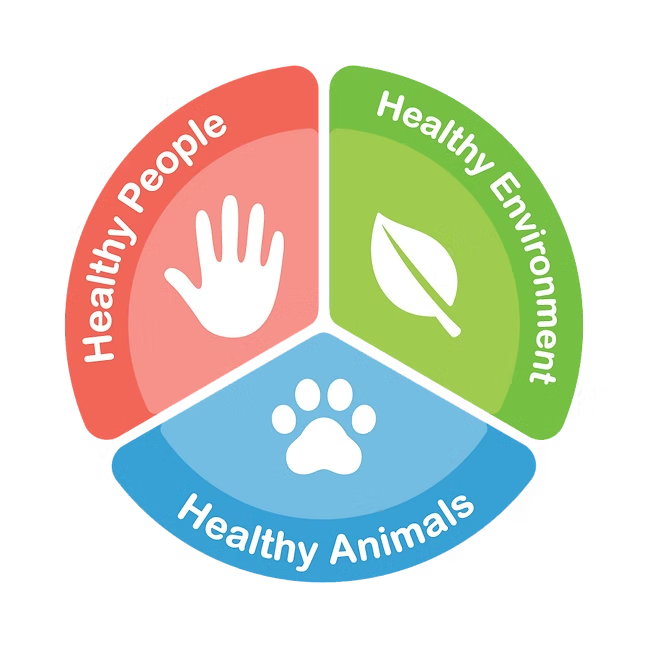
One Health Basics
One Health is a collaborative, multisectoral, and transdisciplinary approach, working at the local, regional, national, and global levels, with the goal of achieving optimal health outcomes recognizing the interconnection between people, animals, plants, and their shared environment.
What is One Health?
One Health is an approach that recognizes that the health of people is closely connected to the health of animals and our shared environment. One Health is not new, but it has become more important in recent years, because many factors have changed interactions between people, animals, plants, and our environment.
- Human populations are growing and expanding into new geographic areas. As a result, more people live in close contact with wild and domestic animals, both livestock and pets. Animals play an important role in our lives, whether for food, fiber, livelihoods, travel, sport, education, or companionship. Close contact with animals and their environments provides more opportunities for diseases to pass between animals and people.
- The earth has experienced changes in climate and land use, such as deforestation and intensive farming practices. Disruptions in environmental conditions and habitats can provide new opportunities for diseases to pass to animals.
- The movement of people, animals, and animal products has increased from international travel and trade. As a result, diseases can spread quickly across borders and around the globe.
These changes have led to the spread of existing or known (endemic) and new or emerging zoonotic diseases, which are diseases that can spread between animals and people. Examples of zoonotic diseases include:
- Rabies
- Salmonella infection
- West Nile virus infection
- Q fever (Coxiella burnetii)
- Anthrax
- Brucellosis
- Lyme disease
- Ringworm
- Ebola
Animals also share our susceptibility to some diseases and environmental hazards. Because of this, they can sometimes serve as early warning signs of potential human illness. For example, birds often die of West Nile virus before people in the same area get sick with West Nile virus infection.
Veterinary studies as a precursor to human maps of disease
- Implications of climate change on the distribution of the tick vector Ixodes scapularis and risk for Lyme disease in the Texas-Mexico transboundary region →
- Prevalence of protozoan parasites in small and medium mammals in Texas, USA →
- Molecular prevalence and ecoregion distribution of select tick-borne pathogens in Texas dogs →
- Molecular identification of Ehrlichia ewingii in a polyarthritic Texas dog →
- Prevalence of common tick-borne pathogens in white-tailed deer and coyotes in south Texas →
- Searching for the immature stages of Ixodes scapularis (Acari: Ixodidae) in leaf litter and soil in Texas →
- Serological detection of tick-borne relapsing fever in Texan domestic dogs →
- Novel real-time PCR assays for genomic group identification of tick-borne relapsing fever species Borrelia hermsii →
- Hassan et al., Vaccine (2019): CRM and TTHc conjugates with PepB →